collage

"Ready to Crow"
Rooster
Painted Paper Mixed Media Collage
by Nancy Standlee

"Feed the Birds"
A bird collage with hand painted papers

"Hight Heel Shoe"
Collage
 |
 |
 |
 |
 |
 |
 |
 |


| SHAPE ON CUBISM Picasso's Woman with Mandolin (1910) further illustrates the groundwork that was being laid by these two artists. Picasso, always the sculptor, fragments the girl's body into facets that are modeled to simulate their projection out of the flat picture plane toward the viewer and that portray her in movement as she strums her mandolin. What Picasso is trying to depict here is the fourth dimension, the space/time continuum. In his Introduction to Metaphysics of 1903, Henri Bergson argues that human consciousness experiences space and time as ever-changing and heterogeneous. With the passage of time, an observer accumulates in his memory a store of perceptual information about a given object in the external visible world, and this accumulated experience becomes the basis for the observer’s conceptual knowledge of that object. By contrast, the intellect or reasoning faculty always represents time and space as homogenous. Bergson argued that intellectual perception led to a fundamentally false representation of the nature of things, that in nature nothing is ever absolutely still. Instead the universe is in a constant state of change or flux. An observer views an object and its surrounding environment as a continuum, fusing into one another. The task of metaphysics, according to Bergson, is to find ways to capture this flux, especially as it is expressed in consciousness. To represent this flux of reality, Picasso began to make references to the fourth dimension by "sticking together" several three-dimensional spaces in a row. | 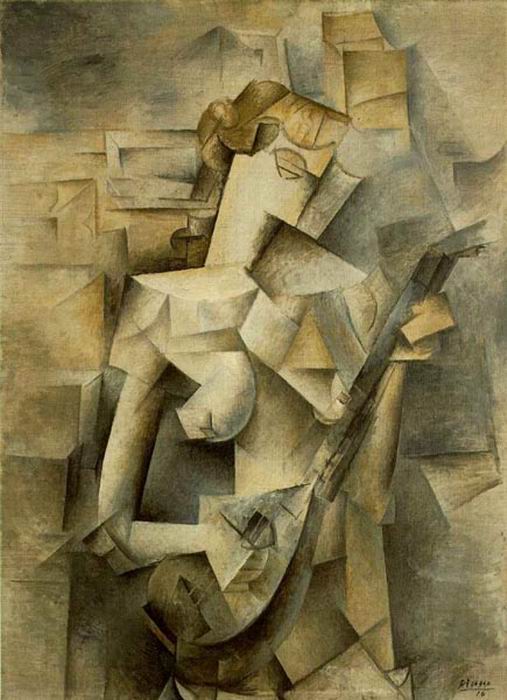 Girl with Mandolin (1910) | |
Pablo Picasso cubism | ||

The technique of faceting originated from Georges Braques - it was his way to depict a natural object. Picasso didn't so much facet natural objects, but used the geometry of Braques' faceted paintings to create a style that was abstract in essence, almost pure abstract art. So cubism refers to the styles of both Braques and Picasso, although Braques' cubism has a recognizable figurative objective, while Picasso's cubism served as the link between Braques' style and pure the abstract art that followed from cubism (such as Piet Mondrian and suprematism).
| ||
 A faisionable object of speculation and intellectualization at the end of the 19th century was the so-called fourth dimension, in which it would be possible to simultaneously discern all sides of a three-dimensional object¹. It seems evident that cubism was a product of the intellectual climate of its time and this may have been of influence on Picasso aiming to depict three dimensional objects in a two dimensional plane. Cubism: origin of the term
To understand where the term cubism comes from, we have to digress on the rivalry that existed between Picasso and Matisse. The latter's Blue Nude painting had caused a public scandal at the Salons des Indépendent (annual Paris art show of contemporary French art) and had caused art critic Louis Vauxcelles to refer to Matisse and his followers as Les Fauves (the wild animals), which led to Fauvism and made Matisse's reputation as the leading avant-garde artist, something he was very fond of. Matisse's reputation had grown to the point that he had been allowed to become one of the Salon's jury members.
When Picasso had produced his Demoiselles, many young artists that had previously followed Matisse, began to follow Picasso is his radical new style of painting. One of the converts was Georges Braque and when he submitted a series of paintings to the Salon, Matisse, who was infuriated by Braque's defection, was instrumental in the Salon's rejection of all of Braques' works. When explaining to Vauxcelles (him again), Matisse made a drawing after one of Braque's landscapes, to show how they were made out of 'little cubes' and from there on "cubism" was a no-brainer for Vauxcelles. This however, had little to do with the technique of faceting that Braque and Picasso went on to develop. Braque's paintings were just a prelude to a very different style, but the term cubism would stick. | ||
| Noteworthy is the work of Piet Mondrian, who linearized cubism in his 1912 "Apple Tree" painting, a process which ultimately led to the first really non-figurative paintings (or pure abstract art), from 1914 on. An important difference between Picasso and the cubist Mondrian was that Picasso never really gave up the third dimension. He played with dimensions, flirted with removing the third, but never became a pure abstract painter. So deeply his figurative upbringing was engrained (he was an artistic prodigy and well-rounded figurative painter at 15), that one of the main creators of abstract art never made it to this development's ultimate consequence: pure abstract art. In that sense Picasso wasn't the radical and revolutionary that, during his cubist period he appeared to become; his cubist period was followed (leaving his cubist converts bewildered) by his neo-classicism, a return to tradition. From there on his recognition and wealth grew and his role as a bringer of fundamental change in the art of painting was over. |  | |
Cubism and Picasso's StyleIt is important to fully realize the importance of cubism. It isn't just "Picasso's style" but marks the real beginning of abstract art. Picasso's predecessors, such as the impressionists, the fauvists and Cezanne were still principally tied to nature as a model to elaborate on. With Les Demoiselles d'Avignon Picasso reached a level of abstraction that was a radical enough break with the classical dominance of content over form, a hierarchy which is reversed in Les Demoiselles d'Avignon and the style which followed from it: Cubism. |  | |
| Speaking of "Picasso's style", it is natural to associate Picasso with Cubism, which leads to people thinking that paintings such as "Femme en pleurs" are cubist. However, Picasso's cubist period ended in 1915 and paintings such as Femme en pleurs (1937, see below) certainly aren't cubist, although there are elements of cubism visible, as well as fauvism and many other styles. There is no -ism that characterizes paintings such as Femme en pleurs and its style is commonly known as, indeed, Picasso's style. Picasso's career is in fact a patchwork of different styles and in his classicist nudes for instance there are hardly any cubist influences visible. Maybe ironically or maybe typically, when Picasso's work could be captured in an -ism, during his cubist period, his influence on art transcended the Picasso style and marked the beginning of a new era in modern art. Picasso's style in its full form is a patchwork of ideas borrowed from classical artists and contempories like and El Greco, Matisse, Modigliani, Gauguin and Toulouse-Lautrec. However, a key-element of the Picasso style is the cubist geometry, which is Picasso's own creation. After his cubist period, Picasso would come to depend on the work of his contempories, from which he would distill the essence, create his own version and incorporate it in his style. After the second world war the School of Paris would not be replaced with an artistic movement of comparable quality, denying Picasso the opportunity to be inspired by, and borrow from contemporary artists, and although he would go on to paint successfully in the Picasso style, he would never again be able to substantially innovate his style. Abstract art may be a 20th century creation, but it also marks the end of a process that started in the 18th century. Long before the invention of photography, philosophers began to question the narrative role of the art of painting, in which naturalism served to create an illusion of reality. Paintings would tell stories and depict actions and emotions; the content of a painting was its central feature, not the painting itself, with its form and color. This would be reversed by the influence of theoreticians like Denis Diderot, Georg Wilhelm Friedrich Hegel, Gotthold Ephraim Lessing, Immanuel Kant and Arthur Schoppenhauer. They felt that the art of painting should not copy nature, but should be an independent art form; the purpose of a painting became the painting itself. This created the ideal philosophical climate for avant garde artists, such as Picasso and Braque, who aimed to move towards abstract art; while the general public doubted their sanity, the cubists could refer to the above-mentioned philosophical tradition. | ||
 |


